Agentic AI vs Generative AI: The Core Differences
Agentic AI systems are increasingly being designed around execution layers. OpenAI’s Agents documentation introduces orchestration concepts such as handoffs, tracing, and tool execution, while Anthropic’s agent engineering guidance focuses on long-running workflows, operational context, and iterative task loops.
Traditional generative AI systems mainly operate through prompt-response interactions. The user provides an instruction, the model generates an output, and the workflow resets for the next prompt.
Google Cloud’s agentic AI overview describes systems capable of reasoning, planning, and autonomous action across connected environments. Mistral’s agent tooling documentation similarly positions function calling and external tool usage as foundational runtime components.
Across these platforms, the direction is consistent: orchestration infrastructure is becoming more important than prompting alone.
| Prompt-Based AI | Agentic AI Systems |
|---|---|
| Single-response interaction | Multi-step task execution |
| User controls workflow flow | Runtime manages orchestration |
| Output generation | Objective completion |
| Limited context persistence | Memory and state handling |
| Repeated prompt iteration | Reasoning and execution loops |
Top Tip: When reviewing modern AI platforms, look for orchestration, memory handling, and tool execution features. Those capabilities increasingly define how vendors position agentic systems.
Anthropic’s long-running harness design discussion also reinforces this shift. The runtime layer manages approvals, checkpoints, execution cycles, and operational context instead of treating the model as a single-response interface.
+--------------------------------------------------------------+
|                    AGENTIC AI WORKFLOW                       |
+------------------------------+-------------------------------+

+--------------------------------------------------------------+
|                      User Objective                          |
+------------------------------+-------------------------------+
                               |
                               v

+--------------------------------------------------------------+
|                       Agent Runtime                          |
|--------------------------------------------------------------|
| Memory Handling | Tool Routing | Reasoning Loop | Context    |
+------------------------------+-------------------------------+
                               |
                               v

+--------------------------------------------------------------+
|                      Execution Layer                         |
|--------------------------------------------------------------|
| APIs | File Operations | Retrieval | Code Tasks              |
+------------------------------+-------------------------------+
                               |
                               v

+--------------------------------------------------------------+
|                       Final Outcome                          |
+--------------------------------------------------------------+
The same pattern is appearing in AI coding tools. Anthropic’s Claude Code and OpenAI’s evolving agent tooling both move beyond isolated prompt completion toward persistent development workflows that interact with repositories, terminals, and execution environments.
For WordPress developers and technical teams, the operational difference is practical rather than theoretical. Traditional AI tools improve isolated tasks. Agentic systems increasingly target workflow coordination by reducing repeated prompting, manual debugging cycles, and human handoffs across development processes.
The aim of this article is not to present agentic AI as a fully-fledged plug-and-play solution, because the industry has not reached that stage yet. However, the emerging direction is becoming increasingly clear, and today’s semi-automated, prompt-driven architectures already reflect many of the early patterns discussed throughout this article. For a practical example of how this evolution is currently appearing in the WordPress ecosystem, see our article on AI in WordPress connected workflows, which mirrors many of the broader industry trends emerging today.
AI Coding Tools: Moving Beyond Prompt Engineering
Agentic AI workflows are becoming especially visible inside coding environments. Earlier AI coding assistants mainly generated snippets from prompts. Current platforms increasingly operate through persistent workflows that inspect repositories, retrieve files, execute tasks, revise outputs, and maintain operational context across sessions.
Anthropic’s Claude Code positions AI directly inside terminal-based development workflows, while OpenAI’s Agents SDK direction focuses on orchestration, tracing, tool execution, and agent loops that extend beyond isolated prompt completion.
This changes the role of prompting itself. Prompt engineering still matters, but the surrounding runtime increasingly handles execution flow, memory management, tool coordination, and iterative reasoning cycles automatically.
| Platform | Observed Direction | Primary Focus |
|---|---|---|
| OpenAI | Agents SDK, orchestration, handoffs | Operational agent runtimes |
| Anthropic | Claude Code , long-running harnesses | Persistent coding workflows |
| Google Cloud | Enterprise agentic systems | Autonomous operational workflows |
Anthropic’s effective agents guidance also places significant attention on workflow design, tool integration, and task decomposition rather than prompt construction alone.
Top Tip: Many modern AI coding tools now compete on orchestration quality rather than generation quality alone. Runtime coordination increasingly matters as much as the underlying model.
+--------------------------+    +------------------------------+
|     Traditional Flow     |    |        Agentic Flow         |
+--------------------------+    +------------------------------+
| Prompt                   |    | Objective                   |
| ↓                        |    | ↓                           |
| Code Output              |    | File Inspection             |
| ↓                        |    | ↓                           |
| Manual Revision          |    | Tool Execution              |
|                          |    | ↓                           |
|                          |    | Iterative Revision          |
|                          |    | ↓                           |
|                          |    | Workflow Completion         |
+--------------------------+    +------------------------------+
OpenAI’s Agents documentation and Mistral’s function calling documentation both reinforce another important pattern: external tools are becoming part of the default AI workflow stack.
That shift affects developer workflows directly. Instead of repeatedly prompting for isolated outputs, agentic systems increasingly coordinate retrieval, execution, reasoning, and revision inside a continuous operational loop.
For WordPress developers, this may eventually reduce time spent switching between documentation, terminals, repositories, debugging tools, and deployment workflows. The value is not only from faster text generation but also from workflow compression across the development process.
Review Claude Code’s workflow documentation to see how modern AI coding environments increasingly operate through persistent agentic interactions rather than isolated prompts.
Control Plane vs Execution Plane: Inside the Agent Runtime
Agentic AI systems increasingly separate orchestration from execution. OpenAI’s Agents SDK overview introduces concepts such as tracing, handoffs, approvals, and execution loops, while Anthropic’s harness design discussion focuses on runtime coordination across long-running tasks.
This separation resembles the control plane and execution plane structure commonly seen in cloud infrastructure. The control layer manages orchestration, permissions, memory, routing, and reasoning flow. The execution layer performs operational tasks such as retrieval, API calls, file handling, or code execution.
+------------------------------------------------+
|                 CONTROL PLANE                  |
|------------------------------------------------|
| Task Routing                                   |
| Memory Management                              |
| Context Handling                               |
| Approvals                                      |
| Reasoning Coordination                         |
| Workflow Orchestration                         |
+----------------------+-------------------------+
                       |
                       v
+------------------------------------------------+
|                EXECUTION PLANE                 |
|------------------------------------------------|
| API Calls                                      |
| File Operations                                |
| Retrieval                                      |
| Tool Execution                                 |
| Sandbox Environments                           |
| Code Tasks                                     |
+------------------------------------------------+
Anthropic’s runtime discussions repeatedly position the model as one component inside a broader operational environment. The surrounding harness manages checkpoints, approvals, retries, and execution continuity rather than relying on isolated prompt-response cycles.
| Runtime Layer | Observed Responsibility |
|---|---|
| Control Plane | Orchestration, reasoning flow, memory, approvals |
| Execution Plane | Tool usage, APIs, retrieval, operational tasks |
| Model Layer | Reasoning and output generation |
Top Tip: Many current AI platforms no longer position the model as the full product. Increasingly, the runtime and orchestration layers define how capable the overall system becomes.
Mistral’s agent tooling documentation similarly emphasizes external tools and execution layers as foundational runtime components. The workflow extends beyond generation into coordinated operational actions.
This architectural direction also explains why concepts such as tracing, approvals, checkpoints, and execution loops now appear directly inside vendor documentation. The focus is shifting from isolated model interaction toward operational system management.
For development teams, the practical implication is workflow consolidation. Instead of manually coordinating multiple disconnected tools, agent runtimes increasingly manage execution flow across coding, retrieval, debugging, and deployment tasks.
What is an AI Agent? Understanding the Architecture
Google Cloud’s agentic AI overview distinguishes between AI agents and agentic AI systems. AI agents operate as task-oriented components, while agentic AI describes the broader system behavior built around reasoning, execution, and orchestration.
Across the current ecosystem, AI agents increasingly function as operational workers inside larger runtimes. OpenAI’s Agents documentation introduces workflows built around tools, handoffs, tracing, and execution loops rather than isolated prompts.
Anthropic’s effective agents guidance also focuses heavily on decomposition, workflow coordination, and operational structure. The emphasis is placed on how systems execute objectives rather than how models answer prompts.
+--------------------------+      +-----------------------------+
|        AI Agent          | ---> |      Connected Systems      |
|--------------------------|      |-----------------------------|
| Goal Management          |      | APIs                        |
| Tool Coordination        |      | Repositories                |
| Memory Usage             |      | Databases                   |
| Context Tracking         |      | Search Systems              |
| Task Execution           |      | External Tools              |
+--------------------------+      +-----------------------------+
This changes how AI systems are evaluated. Earlier discussions focused heavily on prompt quality and output generation. Current agent architectures increasingly focus on coordination, execution continuity, retrieval, approvals, and operational context. OpenAI Agents documentation, Anthropic agent engineering guidance, and Google Cloud’s agentic AI overview all reflect this broader operational direction.
| Traditional Assistant | Agentic System |
|---|---|
| Responds to prompts | Pursues objectives |
| Limited external interaction | Uses connected tools and systems |
| Session-based interaction | Persistent operational workflows |
| User-driven execution | Runtime-managed execution |
Source: OpenAI Agents | Source: Anthropic Effective Agents | Source: Google Cloud Agentic AI
Top Tip: The most useful way to evaluate an AI agent is by observing what the runtime can coordinate, not only what the model can generate.
The same operational direction appears in AI coding tools. Claude Code, OpenAI agent tooling, and runtime-focused documentation increasingly position AI systems inside active workflows rather than isolated chat interfaces.
For WordPress developers and technical teams, this means AI tools may increasingly behave like workflow layers that coordinate documentation, repositories, debugging, deployment, and retrieval tasks across the development process.
The 5 Requirements for Enterprise Agentic Systems
Enterprise agentic systems increasingly depend on orchestration infrastructure rather than model quality alone. OpenAI, Anthropic, Google Cloud, and Mistral all document runtime capabilities that extend beyond prompt-response interactions.
| Requirement | Observed Focus Across Platforms |
|---|---|
| Memory Handling | Persistent context across workflows |
| Tool Orchestration | APIs, retrieval, execution environments |
| Observability | Tracing, checkpoints, workflow visibility |
| Execution Control | Approvals, retries, operational safeguards |
| Runtime Coordination | Task routing and multi-step execution |
OpenAI’s Agents SDK overview introduces tracing and orchestration infrastructure, while Anthropic’s runtime harness discussions focus on operational continuity and execution management.
Top Tip: Enterprise agentic systems increasingly compete on operational reliability and workflow coordination rather than standalone model outputs.
Google Cloud’s agentic AI overview also frames these systems around autonomous reasoning and connected operational workflows rather than isolated generation tasks.
This direction explains why runtime concepts such as tracing, approvals, checkpoints, and orchestration are becoming standard vocabulary across enterprise AI documentation.
Multi-Turn Reasoning: How Autonomous AI Solves Complex Tasks
Multi-turn reasoning increasingly appears as a core runtime behavior inside agentic systems. OpenAI’s Agents documentation and Anthropic’s agent guidance both position iterative execution loops as part of modern AI workflows.
+-------------+    +-------------+    +----------------+    +-------------------+    +----------------------+
|  Objective  | -> |  Reasoning  | -> | Tool Execution | -> | Result Evaluation | -> | Iterative Revision |
+-------------+    +-------------+    +----------------+    +-------------------+    +----------------------+
Instead of resetting after each prompt, agentic systems increasingly maintain operational continuity across retrieval, reasoning, execution, and revision stages.
Top Tip: Multi-turn reasoning is less about longer conversations and more about maintaining execution continuity across complex workflows.
This operational loop appears repeatedly across current vendor documentation because agentic workflows depend on iterative coordination rather than isolated responses.
Standardizing the AI Stack: The Role of ReAct and Model Context Protocol (MCP)
As AI platforms move beyond isolated prompt-response workflows, interoperability becomes increasingly important across the stack. Agentic systems now coordinate tools, APIs, repositories, memory layers, runtimes, and execution environments continuously. Without shared patterns, orchestration workflows quickly become fragmented across vendors and platforms.
This is where concepts such as Model Context Protocol (MCP) and ReAct (Reasoning and Acting) , which is often shortened to Reasoning + Action, begin to matter. Both attempt to make agentic workflows more structured, predictable, and interoperable across operational environments.
ReAct is best understood as a reasoning-and-action workflow pattern rather than a standalone AI product. Instead of generating a single response from a prompt, the system operates through iterative loops that reason about a task, execute an action, evaluate the result, revise the workflow, and continue until the objective is completed.
+------------------------------------------------------------------+
|   Reason   →   Act   →   Observe   →   Revise   →   Repeat       |
+------------------------------------------------------------------+
This execution pattern increasingly appears across agentic runtimes because modern AI systems often need to retrieve information, use external tools, revise outputs, and coordinate multi-step operations continuously rather than respond once and stop.
MCP addresses a different part of the stack. Model Context Protocol focuses on standardizing how AI systems exchange operational context, discover available tools, and understand connected capabilities across environments. As agentic systems interact with repositories, APIs, runtimes, and external services, structured context sharing becomes increasingly important for orchestration consistency.
| AI Stack Concept | The Operational Role |
|---|---|
| ReAct | Standardizes reasoning-and-action execution loops |
| MCP | Standardizes context and capability exchange |
| Function Calling | Connects external tools and operational workflows |
Top Tip: As agentic systems expand, interoperability becomes increasingly important. Runtime coordination now depends on how effectively AI systems exchange context, discover tools, and manage execution workflows.
OpenAI’s orchestration tooling, Anthropic’s runtime discussions, and Mistral’s tool execution infrastructure all reinforce the same broader direction: modern AI systems increasingly depend on coordinated execution layers rather than isolated prompt interactions.
For WordPress developers and technical teams, this shift may become increasingly relevant as AI plugins, automation systems, and operational workflows require more structured ways to exchange capabilities, permissions, runtime context, and execution responsibilities across environments.
Team Velocity: How Agentic Workflows Automate Development
Agentic systems increasingly target workflow compression rather than isolated productivity gains. Google Cloud’s agentic AI overview frames these systems around autonomous reasoning and connected operational execution across environments.
Traditional AI systems mainly improve individual tasks such as writing, summarization, or code generation. Agentic workflows increasingly reduce coordination delays, repeated prompting, debugging loops, retrieval friction, and operational handoffs across teams.
+--------------------------+    +------------------------------+
|  Traditional Workflow    |    |      Agentic Workflow       |
+--------------------------+    +------------------------------+
| Prompt                   |    | Objective                   |
| ↓                        |    | ↓                           |
| Manual Review            |    | Runtime Coordination        |
| ↓                        |    | ↓                           |
| Tool Switching           |    | Tool Execution              |
| ↓                        |    | ↓                           |
| Repeated Iteration       |    | Iterative Completion        |
+--------------------------+    +------------------------------+
Top Tip: The operational value of agentic systems often comes from reducing workflow friction rather than generating faster outputs alone.
Anthropic’s Claude Code and OpenAI’s orchestration tooling both reflect this direction by positioning AI systems directly inside active development workflows.
For WordPress developers and technical teams, the long-term impact may come from workflow consolidation across documentation, debugging, retrieval, repositories, deployment pipelines, and operational coordination.
Conclusion: The Automated Future of Web Development
Agentic AI platforms from OpenAI, Anthropic, Google Cloud, and Mistral increasingly focus on orchestration, runtime coordination, execution loops, and connected operational workflows rather than prompt-only interactions.
Across the current ecosystem, the emphasis is shifting toward systems that coordinate retrieval, execution, reasoning, memory, and tool usage inside persistent operational environments.
OpenAI’s agent runtimes , Anthropic’s harness discussions , Google Cloud’s enterprise framing , and Mistral’s tool execution infrastructure all point toward the same architectural direction: AI systems are increasingly being designed to execute objectives across workflows rather than generate isolated outputs from prompts alone.
At the same time, the industry is still only beginning to experience what agentic AI may eventually become in practice. This is especially visible in the WordPress ecosystem, where AI automation is advancing quickly but fully agentic behavior remains in its early stages. As discussed in our AI in WordPress connected workflows article, technologies like the WordPress Abilities API are still emerging.
As these systems mature, the shift toward more agent-oriented workflows could gradually affect how WordPress developers, technical teams, and site owners approach automation, operational coordination, debugging, upgrades, and broader web workflows. This may become increasingly relevant as technologies like the WordPress Abilities API continue evolving into more structured ways for AI systems and external tools to interact with WordPress capabilities.
⏭️ Read the Next Chapter
Now that you understand the broader shift from traditional generative systems toward increasingly autonomous AI workflows, the next step is seeing how these ideas are beginning to appear within the WordPress ecosystem itself.
👉 Continue to: AI in WordPress: Building Connected Workflows
Frequently Asked Questions
What is the difference between agentic AI and generative AI?
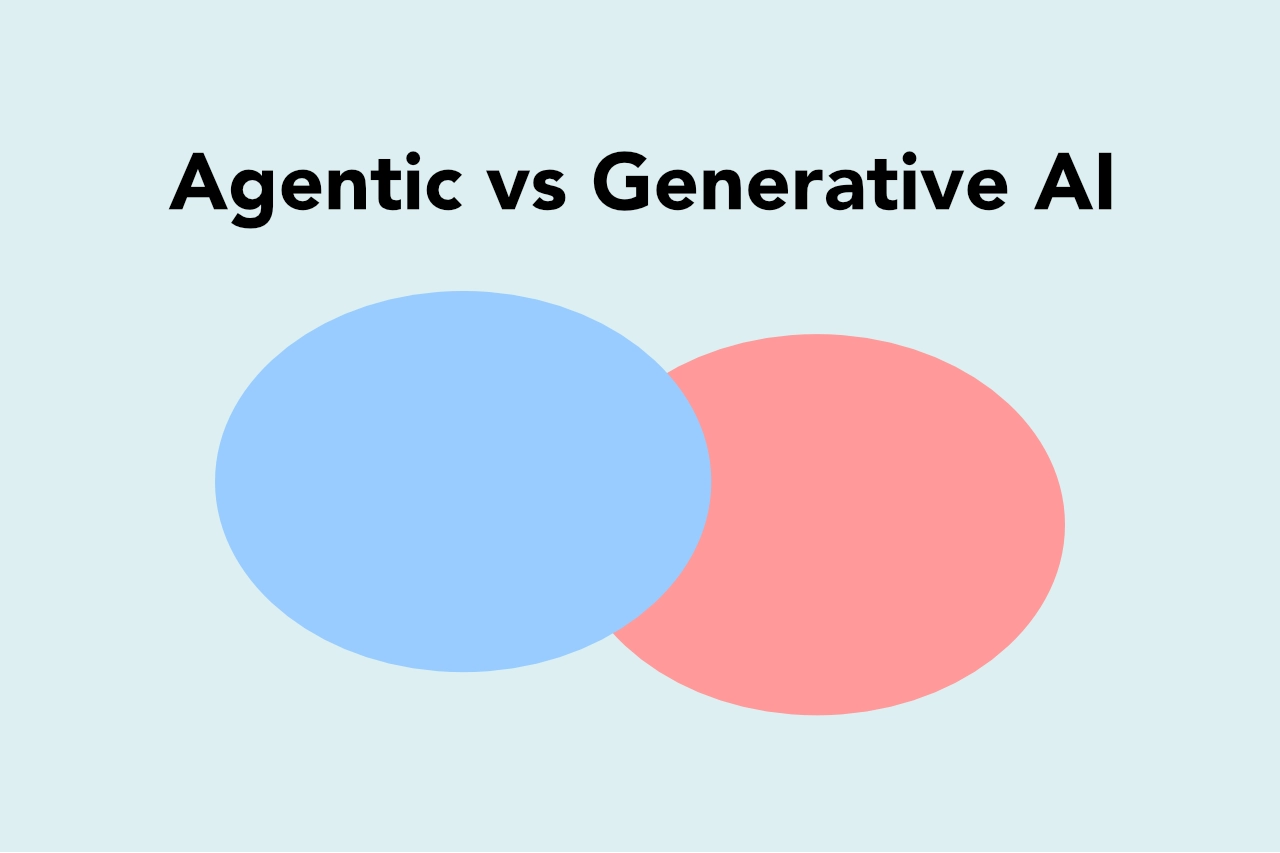
Generative AI primarily produces outputs from prompts, while agentic AI systems increasingly focus on orchestration, execution, memory handling, and multi-step operational workflows.
What is an AI agent?
AI agents operate as task-oriented components inside larger runtimes that coordinate reasoning, retrieval, tool usage, and execution across workflows.
Why are AI platforms focusing on orchestration?
Current AI platforms increasingly position orchestration layers as essential for managing memory, tools, execution loops, approvals, and operational workflows across complex tasks.
What is multi-turn reasoning?
Multi-turn reasoning refers to iterative execution workflows where AI systems retrieve information, evaluate results, revise actions, and continue operational tasks across multiple stages.
How does agentic AI affect development workflows?
Agentic systems increasingly target workflow compression by reducing repeated prompting, manual debugging cycles, coordination delays, and operational handoffs across systems and development environments.